
×
New on the blog
Meet Astro. The AI operating system for AIQ.
"Build me a 20% off campaign for lapsed customers." Astro can have it ready before you finish your coffee. You decide when it sends.
See what Astro can do →New on the blog
"Build me a 20% off campaign for lapsed customers." Astro can have it ready before you finish your coffee. You decide when it sends.
See what Astro can do →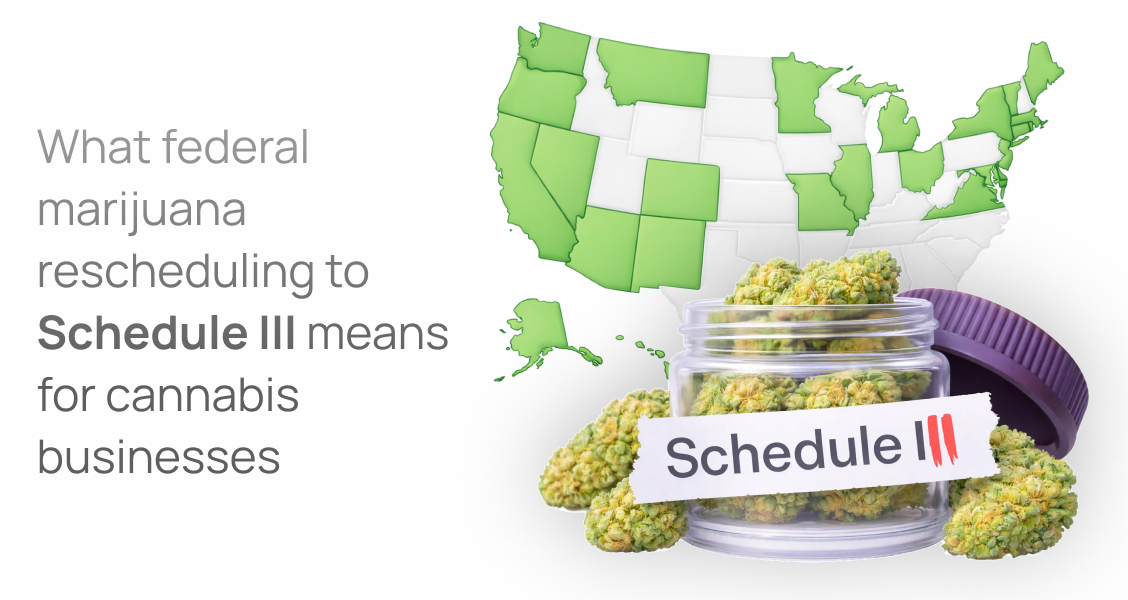
The federal government has officially announced that marijuana will be reclassified from a Schedule I to a Schedule III controlled substance under the Controlled Substances Act.
This marks the most significant shift in federal cannabis policy in decades. While marijuana remains federally regulated and is not legalized nationwide, Schedule III status represents a formal acknowledgment of accepted medical use and a lower potential for abuse under federal law.
For state-licensed cannabis businesses, this change brings meaningful implications, particularly around taxation, research, and regulatory posture, while leaving several long-standing challenges firmly in place.
Below is a clear breakdown of what this change means, what it does not mean, and how operators should think about the path forward.
Marijuana is no longer classified as a Schedule I substance, a category reserved for drugs deemed to have no accepted medical use and a high potential for abuse. Instead, it will be reclassified as a Schedule III substance, alongside drugs that are federally recognized for medical use but remain regulated.
The rescheduling decision has been announced through executive action and will move forward through federal agency rulemaking, including formal implementation by the Drug Enforcement Administration. Until that process is finalized, marijuana remains regulated under existing federal controls.
Importantly, marijuana remains a controlled substance, and federal prohibition has not been repealed.
While the rescheduling announcement is official as of today, the practical effects will roll out over the coming months. Federal agencies must complete rulemaking, guidance updates, and enforcement alignment before Schedule III status is fully operationalized.
Operators should expect a phased transition, not an overnight shift, as agencies clarify compliance expectations and implementation timelines.
One of the most immediate and material impacts of Schedule III status is the removal of cannabis from Internal Revenue Code Section 280E once implementation is complete.
Under Schedule I, cannabis businesses were prohibited from deducting ordinary and necessary business expenses. With Schedule III status, operators may deduct standard expenses such as payroll, rent, marketing, and software, bringing cannabis taxation closer to other regulated industries.
For many operators, this represents a significant reduction in effective federal tax burden and improved operational cash flow.
Schedule III classification significantly lowers federal barriers to scientific and clinical research.
Federal agencies have emphasized the need for expanded research into marijuana’s medical applications, safety profile, and therapeutic potential. Universities, medical institutions, and researchers will face fewer regulatory hurdles when studying cannabis and cannabis-derived compounds.
This shift strengthens the medical legitimacy of cannabis and supports broader data-driven research efforts, though FDA oversight and approval requirements remain in place for any product seeking interstate or prescription use.
Rescheduling removes one of the most significant risk signals for financial institutions: Schedule I classification.
While this may prompt some banks and lenders to re-evaluate their cannabis policies, it does not automatically eliminate federal banking compliance requirements. Full normalization of cannabis banking would still require additional regulatory or legislative action.
Operators should anticipate gradual movement, not immediate universal access.
Schedule III does not reduce expectations around compliance, reporting, or operational transparency. As cannabis moves closer to traditional regulatory frameworks, expectations around audit readiness, data accuracy, and defensible reporting are likely to increase.
State-level regulations governing licensing, sales, marketing, and distribution remain unchanged and continue to apply.
Federal rescheduling signals progress, but it also raises the bar for operational maturity.
Cannabis businesses should prepare for:
This moment rewards operators who already run disciplined, data-driven businesses, and highlights the risks of fragmented systems and manual processes.
AIQ is built to support cannabis businesses through shifting regulatory landscapes.
Our platform helps operators maintain:
As federal policy continues to evolve, operational clarity, transparency, and control become critical, not optional.
We will continue monitoring federal guidance, rulemaking, and downstream impacts to help our customers navigate what comes next with confidence.