×
New on the blog
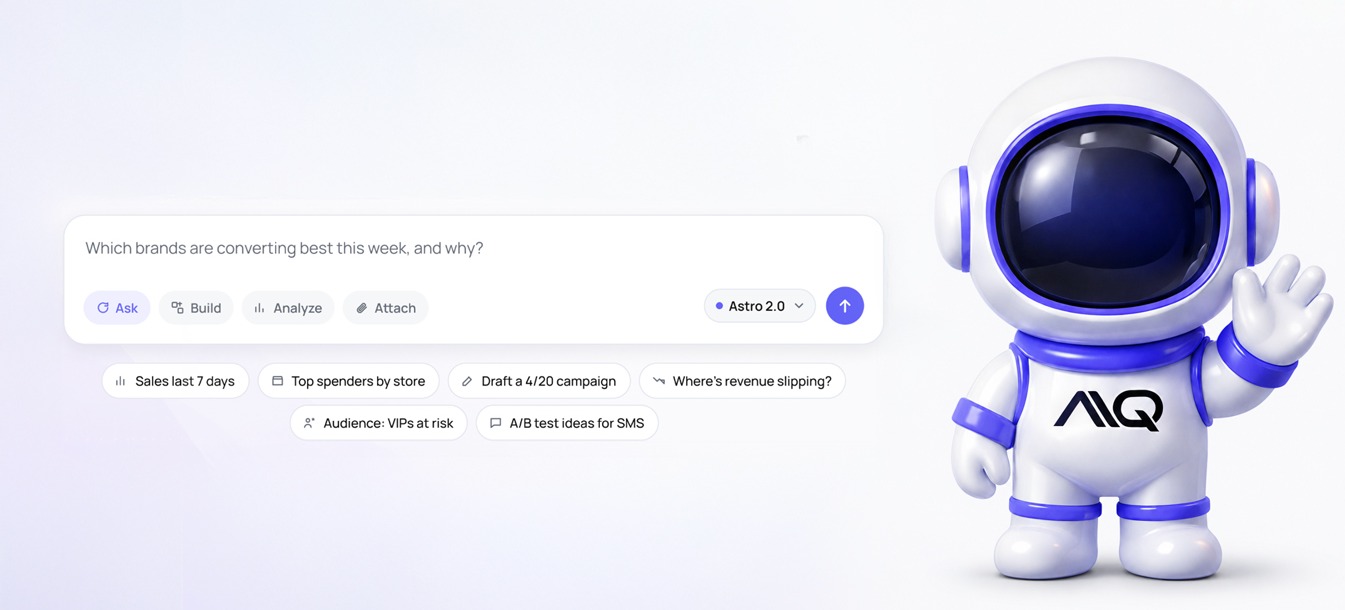
Meet Astro. The AI operating system for AIQ.
"Build me a 20% off campaign for lapsed customers." Astro can have it ready before you finish your coffee. You decide when it sends.
See what Astro can do →New on the blog
"Build me a 20% off campaign for lapsed customers." Astro can have it ready before you finish your coffee. You decide when it sends.
See what Astro can do →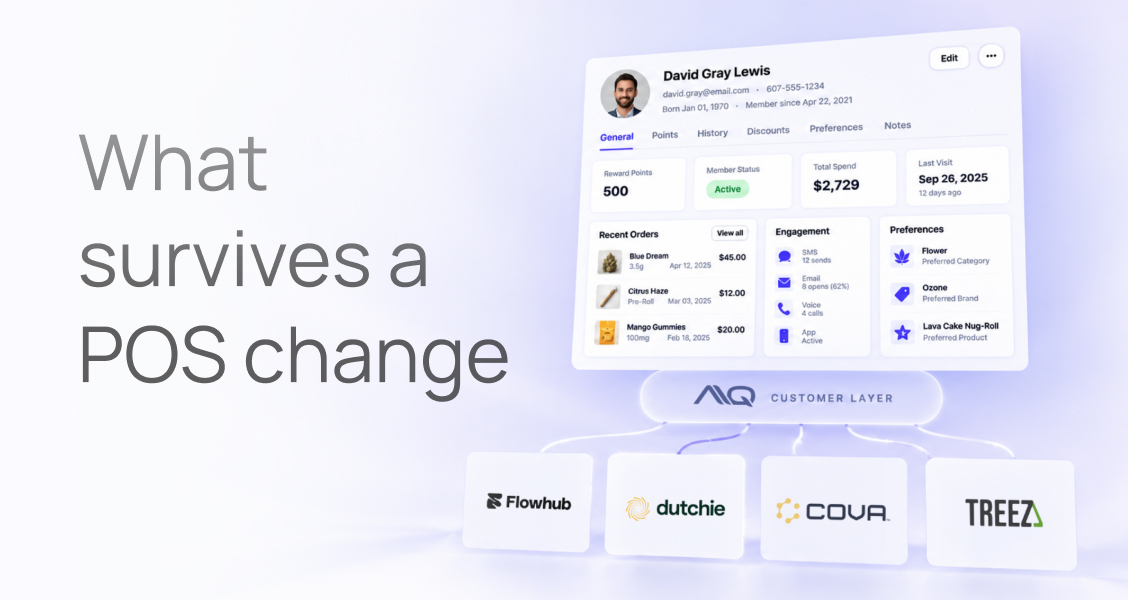
Ask an operator who has switched point of sale systems what the hard part was and almost nobody says the registers. Hardware gets swapped in a weekend. Staff learn the new screens in a week.
The hard part is everything that did not come with them.
Most of what a dispensary owns depreciates. The cases, the safes, the vehicles, the build-out, every terminal on every counter. All of it is worth less this year than last.
One asset moves the other way. Every month you operate, your customer history gets longer. More purchases attached to more people, more campaigns with results behind them, more of the pattern that tells you who comes back and why. A store with five years of it can answer questions a store with five months cannot, and no amount of money closes that gap. The only way to get five years of customer history is to run for five years.
That makes it the most valuable thing in the building and the easiest one to lose, because unlike the safe, it does not sit in the building. It sits in whichever system was holding it.
The pitch for an all-in-one is straightforward and not unreasonable. One vendor, one bill, one support line, everything connected out of the box. For an operator running a single store with no marketing hire, there is a real argument for it.
What the pitch tends to leave out is the coupling. When your loyalty program, your campaign history, your customer profiles and the AI that learned from them all live inside the register, the value of all of it is bounded by that contract. Not because anyone designed it to punish you. Because that is what an integrated suite is.
So the question to ask before you sign one is not whether the features are good. It is what you would still have on the other side of a switch.
That is not a list. That is the thing that makes the list useful, and it does not travel in a spreadsheet.
Cannabis retail is consolidating. Stores change hands, operators pick up locations out of receivership, and the buyer inherits whatever stack was already running. An operator with four stores in three states and two different registers is not an edge case anymore. It is Tuesday.
Every one of those transitions puts the same question on the table. The registers get standardized eventually, because they have to. The customer history does not survive the standardizing unless it was sitting somewhere independent of the registers in the first place.
There is a second pressure worth naming. Every platform in this industry shipped an AI feature in the last eighteen months, and a fair number of them are good. But an AI bundled into a point of sale reads what that point of sale has held, for as long as that contract has run. Change the register and the AI starts over, whatever it knew.
We integrate with Dutchie, Treez, Flowhub, Cova and most other systems operators run. Transaction data comes in, gets matched against the customer profile we already hold, and joins everything else we know about that person.
That is a deliberate architecture, not a limitation. Your register is good at what it does and we are not trying to do it. What we hold is the layer above it: the customer, the history, the engagement, the results.
Which means when the register changes, the layer does not. Point AIQ at the new system, the transactions resume flowing into the same profiles, and everything before the switch is still there. Your loyalty balances hold. Your segments hold. Your campaign history holds. Astro keeps reading the same customer history it was reading last week, going back as far as your account does rather than as far as your newest vendor does.
Three questions, and they apply to us as much as to anyone else.
Every system in your store gets replaced eventually. Registers, scales, cameras, the menu boards. That is normal and none of it should keep you up at night.
What should is anything where replacing the system means losing the years behind it.
Your customer history is the one asset in your store that gets more valuable the longer you run. It should outlive any contract you sign, including ours.