×
New on the blog
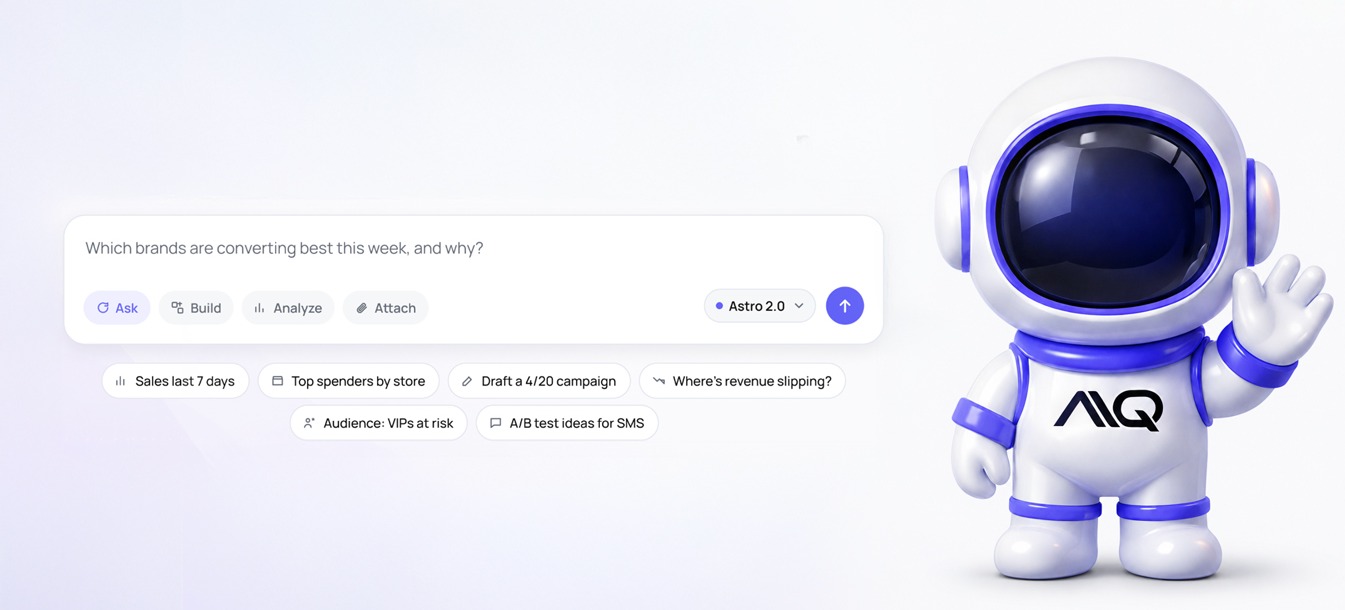
Meet Astro. The AI operating system for AIQ.
"Build me a 20% off campaign for lapsed customers." Astro can have it ready before you finish your coffee. You decide when it sends.
See what Astro can do →New on the blog
"Build me a 20% off campaign for lapsed customers." Astro can have it ready before you finish your coffee. You decide when it sends.
See what Astro can do →.jpg)
More cannabis purchases are being decided before anyone speaks to a budtender.
You can see it on any busy menu. Shoppers arrive interested, but unsure. Many don’t have deep product literacy. They scan categories, prices, and potency, trying to turn a loose preference into a confident choice.
This is where sales either move forward or quietly stall.
It’s exactly where Terpli, AIQ’s AI Sales Agent, was designed to operate.
Despite all the talk about “AI in cannabis,” the buying experience itself hasn’t changed much. Menus still feel crowded. Decisions still feel hard. Too often, AI adds noise without helping people understand what to do.
Terpli exists to address that specific gap: helping shoppers make sense of the menu while they’re deciding, not after the fact.
Most ecommerce systems are built to show products, not help people decide between them.
Filters and sort orders assume shoppers know what they want. Marketing shapes awareness before the menu, but once someone is choosing between similar options, those systems stop influencing the outcome.
The menu is optimized for merchandising and margin, not uncertainty.
Operators see the result every day. When shoppers don’t know what to choose, more options don’t help. They add friction. And that friction gets resolved in one of two ways: staff step in, or the shopper leaves.
An AI Sales Agent only matters if it works right there, inside the menu, at the point where a decision can still change.
Terpli is not a chatbot.
It’s not a bolt-on widget.
And it’s not a replacement for retail teams.
Terpli functions as a sales enablement layer inside the menu itself. It supports discovery, comparison, and choice in real time, when intent is present but still forming.
Put simply, this means:
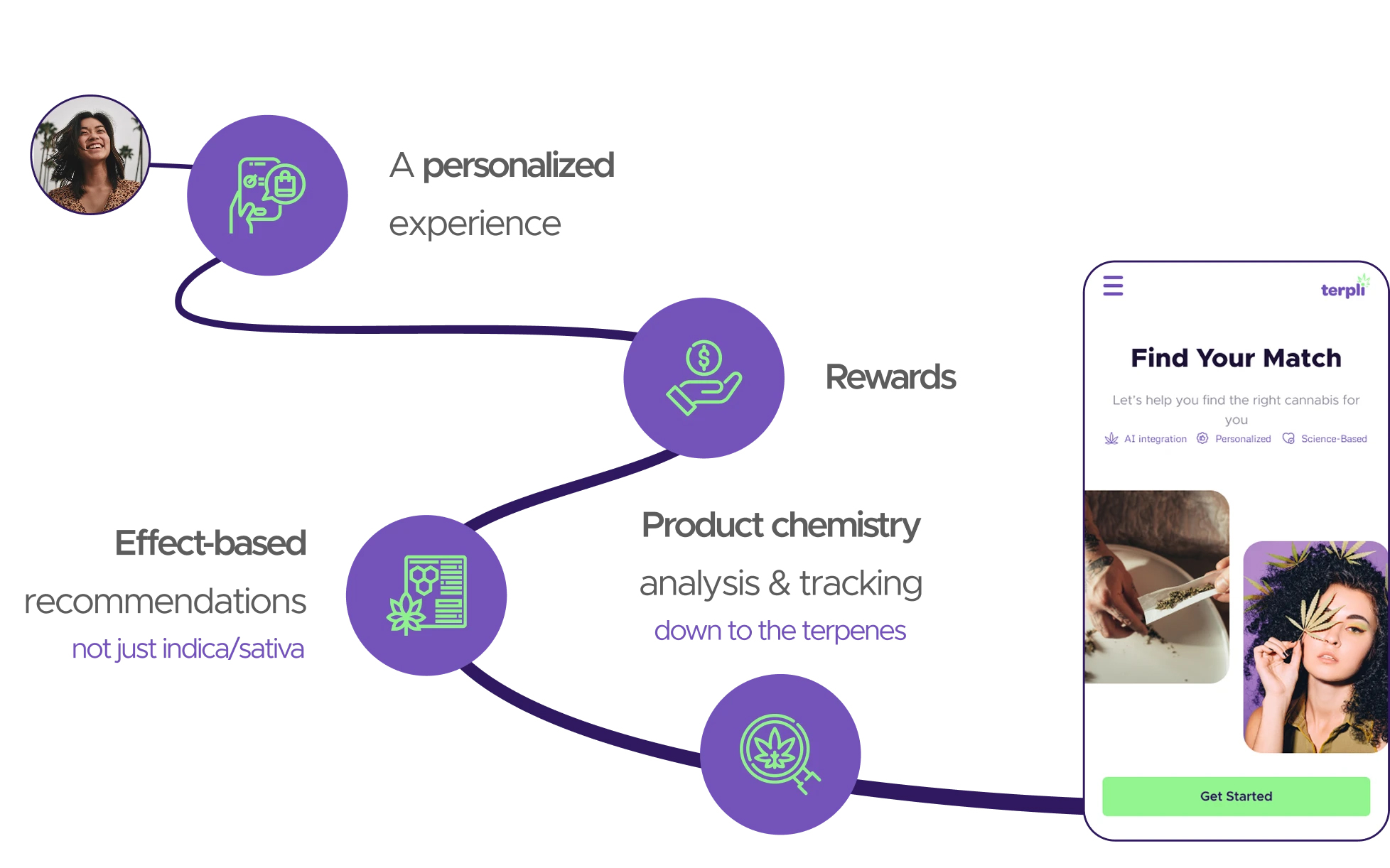
Instead of leaving shoppers to sort through hundreds of SKUs on their own, Terpli brings structure and clarity to the decision process in a way that fits how people actually shop online.
This approach has lasting impact. In one retailer deployment, shoppers who engaged with Terpli saw a 35% higher average order value compared to traditional browsing experiences, a signal that better decisions tend to compound beyond a single transaction.
A true AI Sales Agent is defined as much by restraint as by capability.
Terpli doesn’t flood the menu with more content.
It doesn’t automate the experience into something impersonal.
And it doesn’t attempt to replace the judgment or presence of retail staff.
Its role is to support decision-making, not dominate it.
Terpli works best when it’s connected, but it stays focused on the moment of intent.
Within AIQ, systems like CRM, loyalty, and segmentation provide historical context that informs guidance without overtaking the experience. Tools like Loops help bring shoppers into the menu with context intact, connecting discovery directly to where buying happens.
Each system plays a distinct role. Terpli remains focused on the menu, the shopper, and the decision in front of them.
When the menu helps shoppers decide, a few things change:
Retail teams also feel less pressure to compensate for menu confusion. Staff can focus on higher-value interactions because discovery and comparison are already working.
We’ve seen retailers using our AI Sales Agent at the menu level have reported conversion rate increases of 20% or more, showing that when shoppers are supported as they decide, outcomes shift in measurable ways.
These aren’t promises or guarantees. They’re the natural result of reducing friction at the most critical point in the journey.
Cannabis retail is moving toward quieter, more respectful sales experiences.
The next phase isn’t about novelty or automation for its own sake. It’s about trust. Giving shoppers ownership over their decisions, while supporting them when it matters most.
Terpli, AIQ’s AI Sales Agent, reflects that shift. Not as a replacement for human expertise, but as infrastructure that helps scale better decision-making inside the menu.
The future belongs to systems that help people choose confidently, not the ones that try to sell louder.