×
New on the blog
Meet Astro. The AI operating system for AIQ.
"Build me a 20% off campaign for lapsed customers." Astro can have it ready before you finish your coffee. You decide when it sends.
See what Astro can do →New on the blog
"Build me a 20% off campaign for lapsed customers." Astro can have it ready before you finish your coffee. You decide when it sends.
See what Astro can do →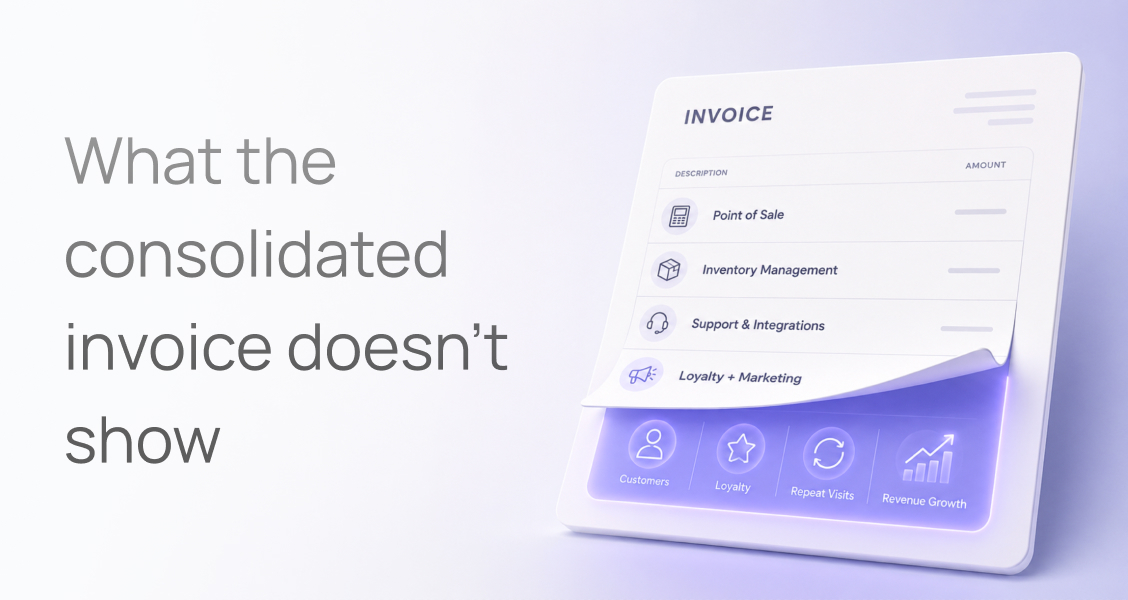
There's a version of the consolidation offer that any finance lead would be right to take seriously. One vendor instead of four, with a single invoice and a single renewal date to track. The bundled price usually lands well below the sum of what it replaces, and the marketing and loyalty piece often gets folded in at close to nothing since the point of sale is already being paid for. Fewer contracts to manage alongside a software line that goes down is a reasonable thing to say yes to on the information usually presented with it.
The information presented with it is the part worth examining. A consolidation offer is nearly always evaluated as a comparison between two software costs, and that comparison is accurate as far as it goes. What it leaves out is that one of the systems being consolidated isn't a cost center in the way the others are.
A point of sale processes transactions that were going to happen regardless, and inventory software tracks product already sitting on the shelf. Both are necessary overhead, and reducing what either one costs is a clean win with no offsetting effect on the top line.
A loyalty and marketing platform sits differently on the P&L, since it exists to change customer behavior and its output shows up as revenue somewhere else entirely instead of as a reduction in cost. Bundling it into a comparison of software expenses leaves price as the only visible attribute, which is unhelpful given that price carries less information than anything else about whether the system is doing its job.
This is where the published numbers deserve a careful look, including ours. Across AIQ's network, customers enrolled in loyalty account for 56% of total revenue and carry 3.6 times the lifetime value of customers who aren't enrolled. A finance reader should push on the direction of causation there, and the push is fair, because some of that gap exists for the simple reason that higher-value customers are more likely to enroll in the first place. The honest version of the claim is narrower and still material. What the program's sophistication determines is how much of that revenue is being actively influenced instead of passively observed, and a program that can trigger on purchase history, point balance, lapse behavior, and redemption patterns influences meaningfully more of it than one that awards points and stops there.
For an evaluation, that shifts the useful question away from what the platform costs and toward what share of revenue currently runs through customers the platform is actively managing, along with what a degradation in that management would be worth.
The shape of this will be familiar from plenty of other contexts. The savings arrive immediately on a line you're already watching, and verifying them takes almost no effort. The costs arrive gradually on a different line, and attributing them back to the decision that caused them is genuinely difficult.
A consolidation that reduces software spend by a knowable amount this quarter might produce a soft decline in repeat purchase rate two or three quarters out. That decline surfaces as a revenue variance, gets discussed in a different meeting, and rarely gets traced back to a platform change made in a prior period. By the time anyone connects the two, the contract has usually renewed once and the original evaluation is a year old.
Consolidation doesn't always cost more than it saves, and plenty of times the trade is clearly right. The point is that the two sides of it get measured with very different precision, so a decision made on the precise side alone is working from partial information.
Beyond the revenue question, several real costs tend to fall outside the number being compared.
Messaging is usually billed separately from the platform. At three to five cents a text, an operation sending a hundred thousand messages a month carries several thousand dollars a month that never appeared in the bundled quote. That figure belongs in the comparison at your actual volume rather than at whatever volume appeared in the proposal.
Per-location pricing behaves differently at scale than it does at signing. A rate that reads as reasonable across four doors compounds directly with expansion, and an operator with growth plans should model the cost at the door count they expect in twenty-four months instead of the one they have today.
Implementation and migration consume staff hours that don't appear on any invoice. Somebody rebuilds the audiences and re-creates the automations, and somebody else handles whatever data doesn't transfer cleanly. Those hours carry a cost even though nobody bills for them.
Years of campaign history, audience segments, engagement data, and loyalty balances add up to a real asset built with real spend. It rarely appears on a balance sheet, which makes it easy to leave out of a switching decision entirely.
The thing worth getting answered in writing, from both the incoming and the outgoing vendor, is what specifically survives a transition, in what format, and how long it takes to arrive. Some arrangements return customer records while dropping the campaign performance history that gave those records context. Others delete data outright on cancellation. A retailer who discovers this after signing has written off an asset they never valued, and the replacement cost gets measured in years of accumulated learning as much as in dollars.
Consolidation offers tend to get evaluated by the people who see the invoice. The person who can describe what the organization would actually lose is the one using the platform daily, and that person often learns about the decision after it's been made.
None of this is really about org charts. It reads better as a diligence gap, since a marketing manager can tell you within an hour which automations are producing revenue and which capabilities in the replacement system don't actually exist yet. That's material information about the value side of a trade being evaluated mostly on the cost side, and it's available for the cost of one conversation.
The fourth question takes the least time to answer and tends to get asked the least often.
AIQ supports more than 4,400 dispensary locations with 86 or more integrations into the systems retailers already run, which means the comparison in front of most operators is rarely our platform against a bundle, and is more often a bundle against keeping the point of sale they already have while running loyalty and marketing on infrastructure built specifically for it.
If a consolidation offer is sitting on your desk right now, we're glad to run the fully loaded math with you at your real volumes, including the parts of it that favor the other option.