×
New on the blog
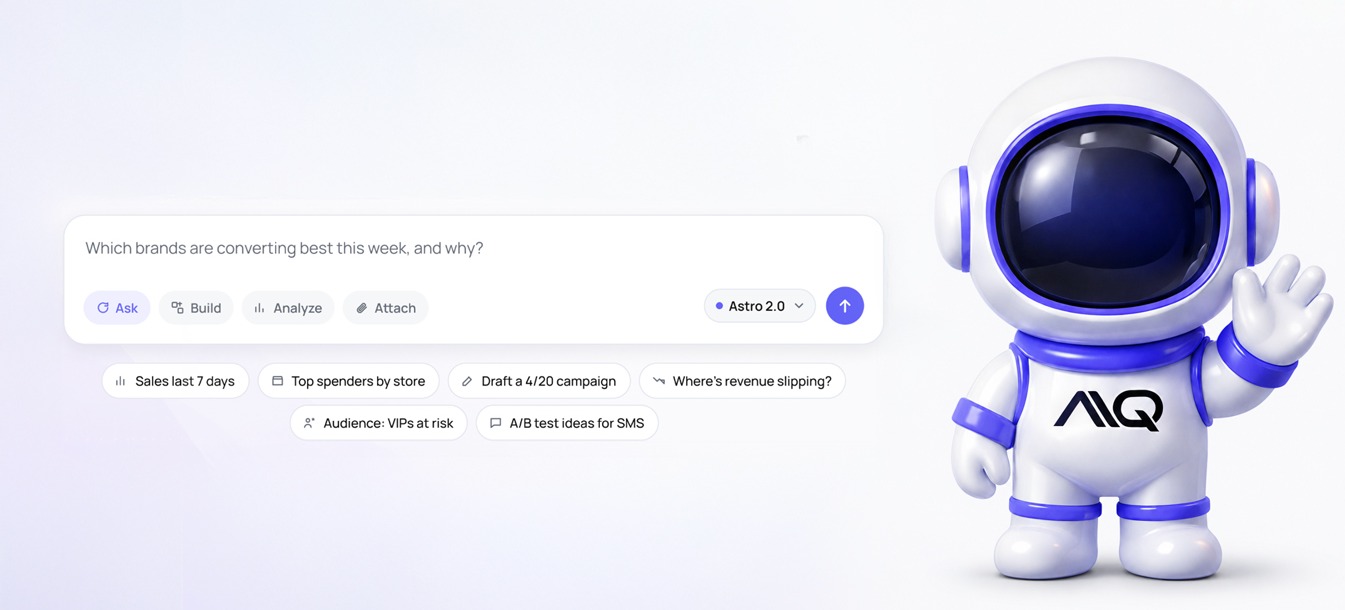
Meet Astro. The AI operating system for AIQ.
"Build me a 20% off campaign for lapsed customers." Astro can have it ready before you finish your coffee. You decide when it sends.
See what Astro can do →New on the blog
"Build me a 20% off campaign for lapsed customers." Astro can have it ready before you finish your coffee. You decide when it sends.
See what Astro can do →
Free for a year. No marketing fees, one platform that runs everything.
Offers like these are everywhere right now, and on the surface they're compelling, especially when margins are tight and every line item on your tech stack feels negotiable.
Before you move your loyalty database and retrain your team, it's worth doing the math the offer skips.
The real cost of a cannabis marketing platform is rarely the monthly fee.
A discounted or waived first year is a customer acquisition strategy. The economics only work if you stay past year one, and staying past year one is what switching costs are built to ensure.
Here's what that free year tends to leave off the invoice:
Implementation and setup fees. Most platforms charge separately for onboarding and data migration. Depending on how many locations you run and how complex your existing setup is, these can range from a few hundred dollars to several thousand. Ask any platform you're evaluating for a complete list of one-time fees before the monthly rate becomes relevant.
Per-location fees. All-in-one POS platforms frequently price by location. A single-store operator looking at a bundled price might not notice that the same contract scales sharply as they grow. Get the per-location rate, not just the headline number.
Support tier costs. A platform that looks affordable at the base tier may require a paid upgrade for anything past ticket-based support, including the onboarding help you'll lean on in the first few months. Understand what support looks like in year one versus year two, and what happens if your dedicated rep moves on.
Message and send fees. This is where the headline rate and the real rate drift furthest apart. Some platforms include messaging in the base price. Others run on a credit system, where a single text can quietly burn several credits, with extras tacked on for things like an attached image or an emoji in the copy. Some also set a minimum credit purchase, so you load more than a campaign needs and carry the unused balance forward. If you send to a loyalty list of any size each week, this is the line that moves the most. Ask for a cost estimate at your actual volume and content, with every credit-consuming element named, before you compare monthly rates.
Add these up across a 24-month commitment and the free year often looks more like a deferred cost than a discount.
There's a second cost that shows up after the ink dries.
A low opening rate can be a real number for the first few months, then climb once you're past the point where switching is easy. Operators who sign on an introductory price often watch it rise a little later, sometimes tied to a push to move more of their stack onto the same vendor.
That push is the part to watch. Consolidation is the pitch, one vendor for POS, ecommerce, loyalty, and marketing. The trade-off is that the more of your operation runs inside a single ecosystem, the harder and more expensive it becomes to change any one piece of it. Some operators describe being steered toward the full suite, with a higher price on what they already use as the alternative.
None of this is visible in month one. It's the shape of year two, and it's worth pricing in before you commit. Ask what the rate looks like six months in, and what would have to happen for it to go up. Then get the answer in the contract.
All-in-one platforms bundle marketing and loyalty alongside POS, ecommerce, inventory, and compliance. The pitch is simple: one vendor, one login.
Platforms built first as POS systems tend to treat marketing and loyalty as secondary features. They work well enough at launch. As you try to run more sophisticated campaigns, like multi-step automations and behavior-based segmentation, you start hitting ceilings that were never in the sales deck.
A four-message cap on an automation path quietly kills a 90-day reactivation flow. When loyalty and marketing sit on separate data layers, you also lose the ability to tailor a message to where a customer actually is, like their current point balance or tier. These limits rarely make it into a demo, and they surface the first time you try to build something with real complexity.
Worth one more flag here: demos tend to sell the roadmap as if it already shipped. If a specific capability is the reason you're switching, ask to see it working in a live account, and get a date in writing for anything described as coming soon.
You won't find this cost on an invoice. It shows up later as revenue you never earned, from the campaigns your tools couldn't run even though you knew they would work. Across AIQ's network, loyalty members generate 3.6x higher lifetime value than non-loyalty members and drive 56% of total revenue. A loyalty program built into your marketing stack and one bolted onto a POS behave very differently over time, and that difference compounds.
One cost hides inside the reporting. A platform that records a conversion whenever a customer got a message and then bought anything within a long window will show ROI that looks great and tells you very little. That dashboard number shapes what you spend next, so it pays to know how it's built. Ask how a conversion is attributed and over what time window before you trust any side-by-side comparison.
If you move to a cheaper platform today and it doesn't deliver, you'll be switching again in 18 to 24 months. Migration costs you twice, once leaving your current platform and once leaving the next one.
The honest comparison is the full 36-month cost of each path, including the version where things don't go to plan. A platform that's cheaper per month but needs a full migration and a retraining cycle, then runs below your old output for a couple of months while the team adjusts, isn't actually cheaper across three years. The discount covered the vendor's acquisition cost. You're still paying yours.
When you're evaluating any cannabis marketing platform, including AIQ, this is the cost structure that gives you an honest comparison:
A platform confident in its value will answer every one of these before you ask for a contract.
The offer that looks cheapest on day one is worth running through this table before you sign. Cannabis retail is a long game, and the platforms worth investing in are the ones built to grow with you.
If you want to run this comparison against AIQ with our actual numbers, talk to our team.