×
New on the blog
Meet Astro. The AI operating system for AIQ.
"Build me a 20% off campaign for lapsed customers." Astro can have it ready before you finish your coffee. You decide when it sends.
See what Astro can do →New on the blog
"Build me a 20% off campaign for lapsed customers." Astro can have it ready before you finish your coffee. You decide when it sends.
See what Astro can do →
"One platform for everything" sounds like the answer.
One login. One contract. One vendor to call when something breaks. For a dispensary operator juggling compliance requirements, staff turnover, and a margin environment that keeps getting tighter, the appeal of consolidation is real.
But there's a difference between a platform that does everything and a platform that does everything well. In cannabis retail, that difference is showing up directly on the bottom line.
The all-in-one POS pitch is built on a structural compromise that most operators don't discover until they've already signed the contract. Understanding what that compromise is, and what a real alternative looks like, is increasingly what separates retailers who are growing from those who are plateauing.
When a POS company adds marketing and loyalty features, it's doing one of two things: building those features natively from scratch, or acquiring a smaller tool and folding it into the existing platform. Either way, the result is the same. The primary product is transaction processing. Marketing and loyalty are additions built around that core.
A POS system is designed to handle transactions accurately, quickly, and in compliance with state regulations. That's a genuinely hard problem, and the companies that solve it well deserve credit. The skills, data models, and engineering priorities that produce a great POS are simply not the same ones that produce a great marketing platform.
Marketing requires deep customer behavioral data, flexible segmentation, multi-channel delivery infrastructure, and automation logic capable of responding to hundreds of different customer signals in real time. Loyalty requires a data layer that's genuinely woven into marketing. Not just the ability to send campaigns to "loyalty members" as a segment, but the ability to use loyalty status, point balance, redemption history, and tier progression as live triggers and conditions inside a campaign.
When a POS company builds these features, they tend to build what's sufficient to check the box on a feature comparison. What they build less often is the depth that makes those features produce results at scale.
"Our POS handles transactions exactly the way we need it to. But we needed deeper segmentation, automations that could scale, and loyalty data that talks to our campaigns in real time. We needed a platform solely focused on really understanding our customers. That's AIQ, and the difference showed up immediately."
The ceiling isn't visible on day one. Basic campaigns run fine. Welcome messages go out. Birthday texts get sent. The dashboard looks clean.
The ceiling appears when you try to build something more sophisticated.
Automation depth. The workflows that actually drive retention aren't three steps long. They're multi-branch sequences that respond to whether a customer opened a message, redeemed an offer, came back after receiving an SMS, or went quiet for 45 days. Building those sequences requires automation tools without hard limits on path length, message count, or time delays. When those limits exist, and in all-in-one platforms they typically do, operators hit them faster than expected. The workaround is manual patching, which is the opposite of automation.
Loyalty and marketing operating as separate systems. The most effective customer communications reflect what a customer is actually doing with your loyalty program. A message that says "You're 200 points away from your next reward" requires your marketing tool to know, in real time, what that customer's point balance is. A suppression rule that stops a discount offer from going to someone who already redeemed one this week requires your marketing tool to see redemption history. In platforms where loyalty and marketing are bolted together rather than natively integrated, that kind of data sharing is limited or doesn't exist.
Segmentation ceiling. Cannabis retail customers are not a single audience. High-frequency buyers, occasional weekend shoppers, deal-chasers, brand loyalists, customers who haven't visited in 60 days. Each group responds to different messaging, different offers, and different timing. Deep segmentation requires clean, deduplicated customer data and a flexible filtering system. All-in-one platforms that inherited their customer data model from a POS, where the primary identifier is a transaction rather than a customer, often struggle to deliver this.
Channel breadth. SMS is the highest-performing channel in cannabis marketing and also the most heavily regulated. Beyond SMS, the operators who reach customers most effectively are the ones who can connect across multiple touchpoints: email, push notifications, direct mail, voice drop. Each channel requires its own compliance infrastructure and delivery architecture. A platform that added marketing as a feature is less likely to have built that infrastructure across every channel than one where messaging was the core product from the start.
The features that don't make the all-in-one platform's marketing page aren't just inconvenient. They carry a dollar value.
Across AIQ's network of 4,400+ retail locations and 1.2 billion transactions processed, loyalty members generate 3.6x higher lifetime value than non-loyalty members. They drive 56% of total revenue. They visit 11% more frequently. These outcomes don't happen automatically because a loyalty program exists. They happen because loyalty is genuinely connected to marketing, because campaigns reflect actual customer behavior, and because the platform was purpose-built to produce those results.
The gap between "loyalty program exists" and "loyalty program is producing 3.6x LTV" is exactly the gap between a feature bolted onto a POS and a platform built specifically for cannabis retail marketing.
There's an important distinction between consolidation and connection.
Consolidation means fewer vendors. Connection means the vendors you have are genuinely sharing data, communicating in real time, and making each other more effective.
The retailers performing best in 2026 aren't necessarily the ones who reduced their tech stack to a single vendor. They're the ones whose tools actually work together. The POS informs the marketing platform. The marketing platform informs the loyalty engine. The loyalty engine shapes the ecommerce experience. A customer's history with your brand follows them across every touchpoint.
That kind of connection doesn't require every tool to come from the same company. It requires that each tool in your stack be best-in-class at its specific job, and that the integrations between them are deep enough to pass the data that actually matters.
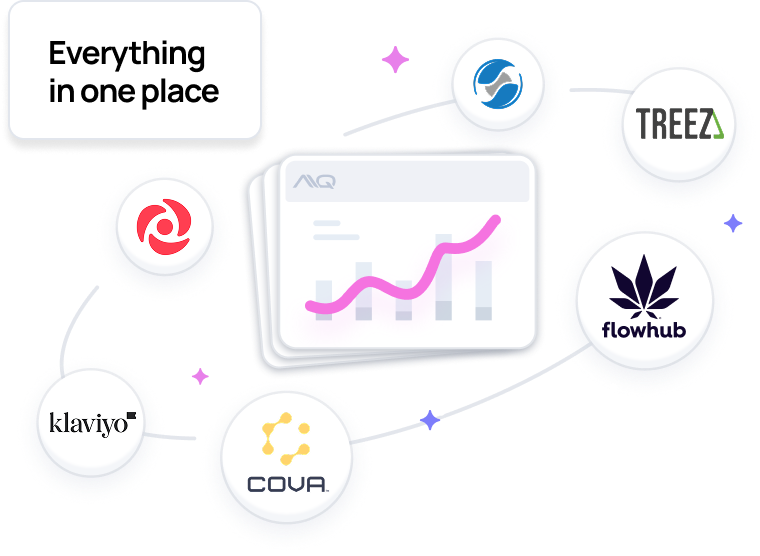
AIQ integrates with 86+ technology partners across the cannabis retail ecosystem, including POS systems, ecommerce platforms, compliance tools, and delivery software. The model isn't "replace everything with one platform." It's "connect the best tools in the industry so the whole stack performs better than any of the parts would alone."
That's a different philosophy from all-in-one. It's built on a specific belief: the retailers who win over the next five years will be the ones with the richest customer data, the most capable marketing infrastructure, and the deepest loyalty architecture. Those things are more likely to come from a platform where they're the primary focus than from one where they were added later.
If you're evaluating your current platform or considering a switch, the question isn't "does this platform have marketing and loyalty?" Every platform does. The more useful marketing questions are:
The answers will tell you whether you're looking at a marketing platform or a marketing feature.
Cannabis retail in 2026 is not a simple operating environment. The operators who are growing consistently are the ones with marketing and loyalty infrastructure sophisticated enough to match the complexity of their customer base. That sophistication is increasingly what separates retailers who grow from those who plateau.
1 in 3 cannabis transactions in the US comes though AIQ. That scale represents the data, the integrations, and the institutional knowledge that come from being the platform cannabis retail's top performers chose to build on.
If you're wondering whether your current platform is built for where retail is going, we'll show you the difference.