×
New on the blog
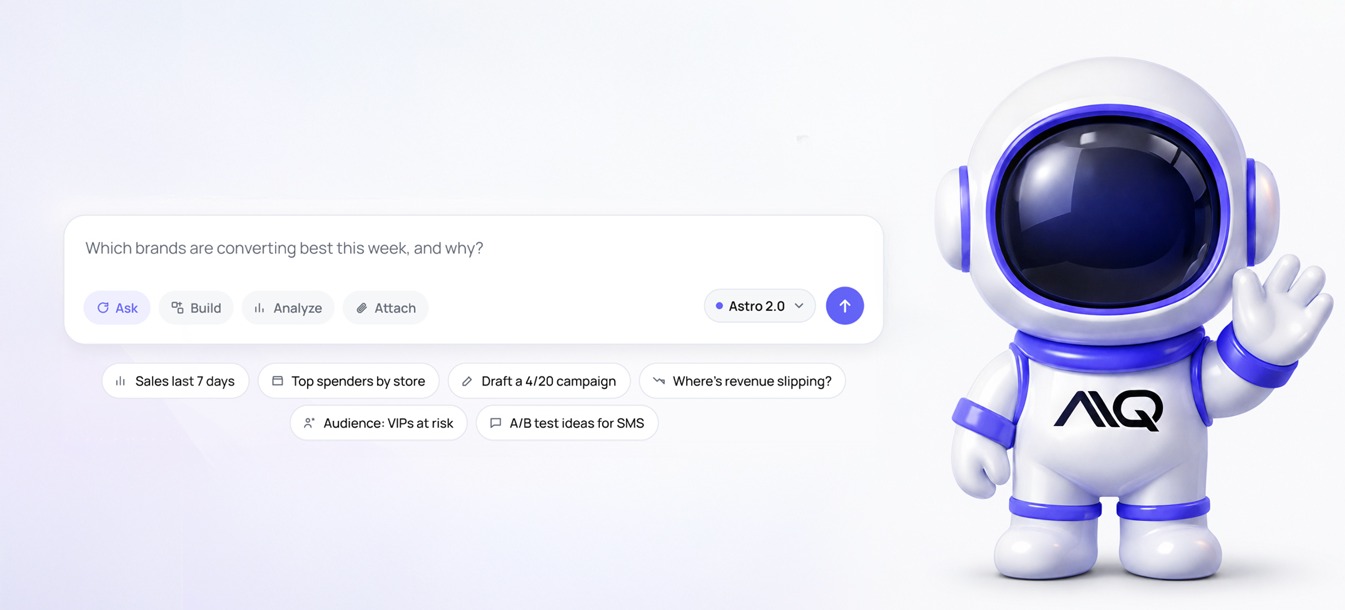
Meet Astro. The AI operating system for AIQ.
"Build me a 20% off campaign for lapsed customers." Astro can have it ready before you finish your coffee. You decide when it sends.
See what Astro can do →New on the blog
"Build me a 20% off campaign for lapsed customers." Astro can have it ready before you finish your coffee. You decide when it sends.
See what Astro can do →
When Gold Standard takes over a new dispensary's AIQ account, they know roughly what they are going to find before they log in.
"One of the things that we see, regardless of how long they've been open, is the first hurdle we have to get almost everyone over is the opt-in," says Kyra, who runs client strategy at Gold Standard and previously managed a hundred thousand member loyalty list for a nineteen store chain. "And it's specifically the communications opt-in."
There are a few versions of the problem. Some stores collect nothing at all. Some try and give up when a customer says no. The third version is the one that bothers her most, because on paper it looks like success.
"They're getting them opted into loyalty, but not email or text, which is kind of my least favorite. Because now you're carrying a liability and you can't contact them. You can't run that retention marketing, you can't find incremental revenue."
That store has a customer count. The dashboard shows members. What it does not have is a way to reach any of them, which means every retention feature in the platform is sitting there with nothing to operate on.
"There are features that are underutilized, yes," Kyra says.
The usual diagnosis is that budtenders need to try harder. Kyra's diagnosis is different. The ask itself is built wrong, so the customer has no reason to say yes.
Here is how the conversation sounds in most stores:
"Hey, do you want to opt in for messaging?" "No, I'm okay." "Okay."
And the transaction moves on. The budtender did ask. The customer did decline. Nothing about that exchange gave them a reason to do otherwise.
"They attempt it, but they don't know how to overcome objections, because the strategy doesn't really match that customer experience," Kyra says. "You have to think about how to fill that gap."
The version she coaches has the value stated up front, before the customer has to decide anything:
"Hey, do you want to opt in? You're going to get 50 points for this purchase, and you'll have 20% off in your inbox next time."
Same moment at the register, same ten seconds. The difference is that the customer now knows what they get and when they get it.
"That's what you always want to see," she says. "An easy yes."
A script only goes so far if the person delivering it has nothing in front of them. Gold Standard treats the sign-up moment as a production problem rather than a training problem.
"We're producing 4 by 6 graphics, we're producing banners that go inside the store, we're creating content for them with QR codes so that their life is as easy as possible," Stephen Gold says. "To get that email address and that phone number."
They also sit with staff directly. Kyra runs Zoom sessions with ten or fifteen employees at a time, walking through the back end of whatever POS the store runs so that the data gets entered correctly in the first place.
"We can't be there with their budtenders to coach all their budtenders," Stephen says, which is exactly why the materials matter. The store that hands a budtender a clear ask, a visible offer on the counter, and a QR code gets a different opt-in rate than the store that hands them a reminder in a Monday meeting.
Kyra frames the platform's role plainly. AIQ is the bullhorn. The job on the ground is to give the staff the ammunition and grow the audience, and then the reconciliation of that data is where the marketing actually starts.
Once the list exists, the question becomes what you can actually do with it. Gold Standard has run campaigns across a lot of different retail stacks, and when asked what AIQ gives them that others have not, Kyra's answer is specific.
"We always come back to the segmentation and the analytics. The segmentation between the amount of conditions you have, the nesting and predictive analytics, plus being able to see campaign analytics versus retail. Those all married together has allowed us to get so much more granular with AIQ than we have in other tech stacks."
The part worth sitting with is the last piece. Campaign analytics tell you what a send did. Retail analytics tell you what the store did. Most operators look at these in separate tabs and connect them by intuition. Seeing them against each other is what turns a segment from a guess into a decision.
Stephen pushes on how operators typically use segmentation, which is usually by product category.
"People who smoke flower probably buy pre-rolls, and probably buy a vape cartridge. There is a lot of crossover. So while that is a smart segmentation, there are a lot of other really cool segmentations to be done to see differences within your audience."
He also points out that the real work is not the obvious kind. Taking an audience of four thousand and sending to a small slice of it. Layering plain text sends in among the designed ones to keep the cadence from feeling like a billboard. Knowing when HTML helps and when it gets in the way.
Ask Kyra what operators are most commonly leaving on the table, assuming the list is handled, and the answer is immediate.
"Workflows. Because that is just a bank of incremental revenue waiting for you to tap into it."
The appeal is that workflows cost you once. You build the logic, and from then on the campaigns run against customer behavior without anyone pushing a button. A customer who bought a cart three weeks ago gets a different message than one who has not come in since July, and nobody on your team has to notice.
"It's a more curated experience where it's running in the back end, so you don't have to go in and push buttons constantly," Kyra says. "That level of customization to the shopping experience, in our experience, is what converts higher. It is what drives a higher revenue per dollar."
The part most operators skip is that the small configuration details carry real weight too.
"It even funnels down to the small things. Are you using your macros? Are you linking to the favorite stores correctly? Even small tweaks like personalizing with macros, we'll see 50 to 60 percent lift just by leveraging those features."
A workflow build is a real project. Checking whether your macros are firing and your store links point to the right location is an afternoon.
We asked Gold Standard what a dispensary should fix if they could only fix one thing in the next ninety days. Josh Bleviss did not hedge.
"The second a new customer walks in, on that first transaction, we're gathering their data. We're opting them into loyalty. We have a welcome flow set up with several emails that are going to be offering compelling calls to action to get this customer to build a habit of shopping three times within the first 45 days."
That number is the whole strategy in one line. Three visits, forty five days. A customer who hits it has a pattern. A customer who buys once and goes quiet is someone you will be trying to win back six months from now at considerably more effort and expense.
It also explains why the opt-in sits at the front of this piece. The welcome flow cannot run if you did not capture an email address at the register. The forty five day window is already closing while the customer walks out the door.
Josh's framing of the market pressure connects directly to it. As prices compress and stores multiply, the operators who hold their ground are the ones "building that habit of retention on the first visit."
Stephen added something to Josh's answer that is worth repeating, because it is the limit on everything above.
"We want to make sure that they have a good experience in store, because the data can only do so much. If they walk in, and your budtender's eating a hamburger behind the register, and looking sloppy, and not saying hello, and not knowing the product mix that you have on your shelves, there's nothing we can do to help you."
You can run a perfect welcome flow into a bad first visit and all you have done is pay to introduce someone to a store they will not return to.
His point lands harder in a market where the competition is a thousand feet away. "I don't need to come to your store. Give me a reason to come in. Everyone has the same product. What's your differentiator? A lot of times it's just treating that customer right and making them feel like they're at home."
The marketing brings them back. The staff decides whether that was worth doing.